
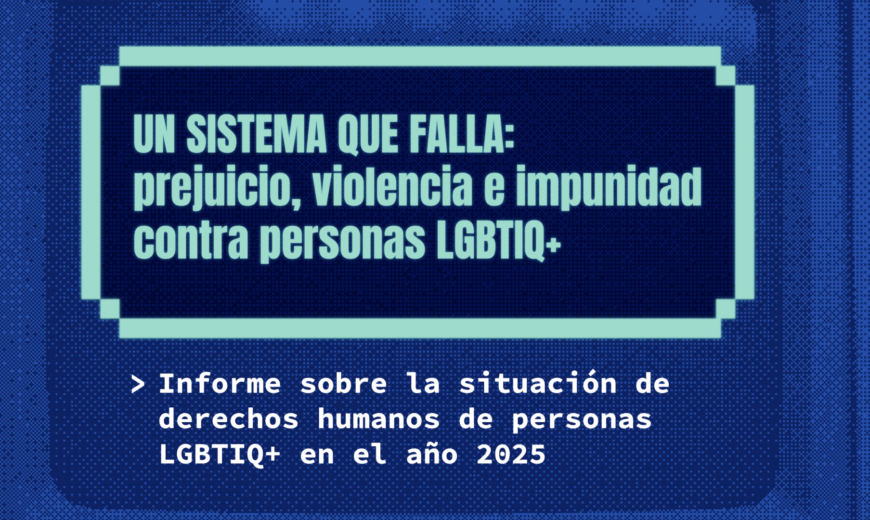
The most recent report on the human rights situation of LGBTIQ+ persons in Colombia, produced by Caribe Afirmativo, reveals a structural crisis marked by the rise of prejudice-based violence, its territorial expansion, and an insufficient State response. Entitled “A System That Fails: Prejudice, Violence, and Impunity Against LGBTIQ+ Persons,” the report shows that in 2025, one LGBTIQ+ person was killed every 32 hours, confirming that violence is not an isolated phenomenon, but rather systematic and persistent.
A system of violence that escalates to death
The report documents that attacks against LGBTIQ+ persons follow a continuum of violence that begins with discrimination and can culminate in homicide: discrimination → domestic violence → sexual violence → threats → homicide → impunity.
“LGBTIQ+ persons do not die only when they are killed. Violence begins much earlier—in rejection, exclusion, and threats that the State fails to prevent,” the report states.
More than 1,100 people threatened: the prelude to lethal violence
During 2025, 1,184 victims of threats were recorded, consolidating threats as one of the most widespread forms of violence. These threats are not isolated incidents; they function as mechanisms of territorial control, regulate the visibility of LGBTIQ+ persons, and silence social leadership. The report warns that, in multiple cases, homicide victims had previously been threatened, revealing serious failures in prevention and protection.
The home and the digital sphere: new settings of violence
Violence does not occur only in public spaces. The report reveals that 1,531 cases of domestic violence were recorded, making it the most widespread form of aggression, and 628 cases of sexual violence were documented, with a high impact on lesbian and bisexual women.
The report identifies digital violence as a determining factor in the escalation of violence, functioning as a catalyst for physical aggression, an amplifier of hate, and a mechanism for exposure and persecution. Documented practices include doxxing (exposure of personal data), identity theft, revenge porn, and systematic harassment. These practices have tangible consequences, including forced displacement, mental health impacts, loss of employment, and reduced public participation.
A violence with geography: cities and contested territories
The report states that most of the cases have occurred in major urban centers such as Bogotá, Antioquia, and Valle del Cauca, but also expand into territories with the presence of armed actors and illegal economies. This demonstrates that violence against LGBTIQ+ persons is linked to dynamics of territorial control and armed conflict, where dissident bodies become objects of violent regulation.
Two clear territorial trends are identified:
- A high concentration in major urban centers, where both reporting and levels of violence are higher; and
- An expansion into territories characterized by illegal economic corridors and weak State presence.
The State fails to prevent, document, and sanction
The report identifies serious institutional deficiencies: systematic underreporting of cases, lack of variables on sexual orientation and gender identity, fragmentation in data production, and high levels of impunity. For its preparation, 160 information requests were sent to public entities, many of which were unable to respond fully or adequately.
“The absence of data is not a technical problem; it is a form of invisibilization that prevents effective action,” the document warns.
The report raises key strategic alerts:
- There is a critical gap between formal rights and their effective guarantees
- Violence is also linked to dynamics of armed conflict and illegal economies
- Underreporting limits State action and international cooperation
The report concludes that violence against LGBTIQ+ persons in Colombia is the result of a system that fails at multiple levels: social, institutional, and territorial. In this context, it calls on the Colombian State and the international community to:
- Strengthen information systems with a differential approach
- Implement effective prevention mechanisms in response to threats
- Ensure investigations incorporate a bias-based approach
- Adopt structural policies that address the root causes of violence
The evidence is clear: violence against LGBTIQ+ persons in Colombia does not begin with homicide, but with tolerated prejudice and ignored threats. In 2025, the State not only failed to protect—it also failed to count, investigate, and sanction. The crisis is not invisible. It is structural. And it requires an urgent, comprehensive, and sustained response.